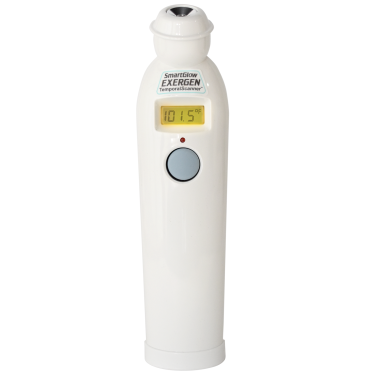
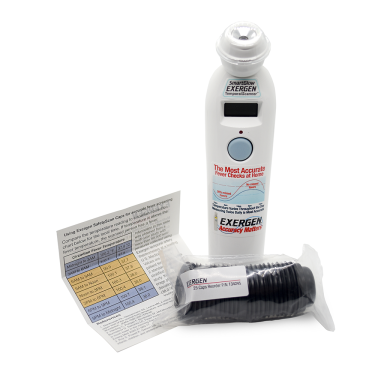
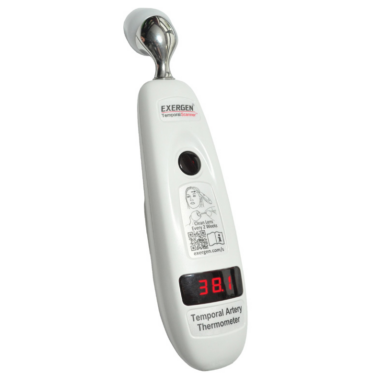
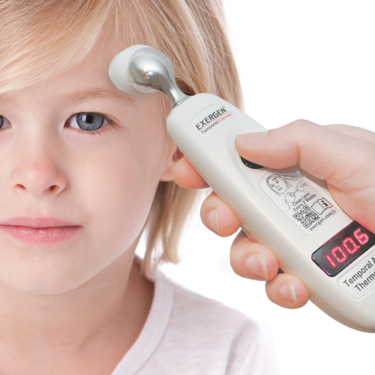
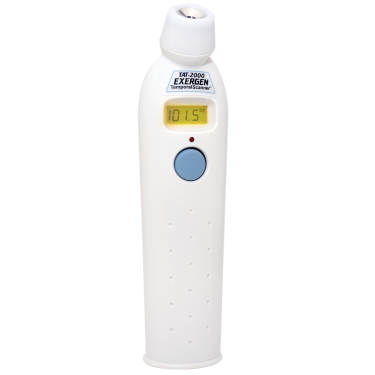
The pressure on hospital nurses is increasing. With a growing number of patients and a shortage of new colleagues, productivity is essential. Exergen, manufacturer of Temporal Artery Thermometers, aims to support this by providing innovative solutions that not only save time but also improve accuracy and efficiency.
Manual Processes and Error-Proneness
When measuring body temperature—one of the vital signs of a patient—nurses often find that manual note-taking creates problems. Patient identity and temperature data are recorded on paper, with a tablet, or via a computer on wheels. This method is error-prone and time-consuming, since mistakes must later be corrected. This costs valuable time that nurses could better spend elsewhere.
To address this, Exergen is developing new models of its well-known Temporal Artery Thermometer equipped with a built-in secondary scanner. This scanner can read the barcode on a patient’s wristband and link it to the precisely measured temperature. In this way, both pieces of information are captured in a single digital data package, preventing errors and significantly improving productivity.
Digital Connectivity as a Key Factor
The next step is to integrate this digital data directly and efficiently into patient records. Exergen is working on multiple connectivity options. Temporal Artery Thermometers are already often connected by cable to a monitor such as a Vital Signs Monitor (VSM). The number of compatible monitors increases each year, but Exergen is looking beyond that.
With wireless communication via Bluetooth—and in the future possibly also Wi-Fi and 5G—data such as temperature and patient identity can be quickly transmitted to a computer on wheels, a VSM, or even directly to the patient record. It is, of course, up to each hospital to decide which workflow suits them best. Exergen relies on internationally standardized data formats such as HL7 or FHIR, ensuring broad compatibility with existing systems. In addition, all data is always transmitted in encrypted form to safeguard patient privacy and security.
The Rise of Home Care and Telehealth
These innovations benefit not only hospitals. The growing role of telehealth increases access to care, especially for patients who cannot regularly visit a hospital. With reliable internet connections, patients can be monitored remotely, and data from such smart thermometers can be seamlessly shared with healthcare providers. This enables more personalized and improved care delivery.
For home care, wirelessly communicating thermometers provide direct added value. Elderly patients, for example, can measure their temperature at home while their healthcare provider receives the data in real time. This strengthens the role of technology in modern healthcare and reduces the need for frequent hospital visits.
Proof of Concept and Pilot Projects
Exergen has already developed several proof-of-concept models of these connected thermometers. These are currently being tested in the first hospitals. Models with integrated patient identification scanners will follow in the near future.
During these tests, Exergen is not only examining the technological performance but also, together with the hospitals involved, evaluating the impact on nurses ’workflows. Using a digital scanner for patient identification may bring changes to how nurses interact with patients. For this reason,
Exergen places great importance on training and support, ensuring that users are well-prepared for these new technologies.
Training as the Key to Success
To unlock the full potential of these innovations, Exergen continuously invests in training for nurses and biomedical engineers. Even intuitive devices like the Temporal Artery Thermometer require attention to detail, such as cleaning the lens. Training programs are regularly updated to help nurses use new functions, such as the scanner and wireless connectivity. This approach enhances not only the technology but also daily care practices.
The future of healthcare lies in combining technological innovations with professional development. With solutions such as integrated patient-ID scanners and wireless communication, Exergen provides nurses with the tools to work more efficiently, reduce errors, and spend more time on what truly matters: caring for patients. Innovations like these are a crucial step in building connected, efficient, and patient-centered healthcare.
Exergen P/N 850555, Rev 1
